
A Beginner’s Guide
If you have ever felt as though different parts of you are pulling in opposite directions, you are not alone. Perhaps one part wants to speak up in a meeting while another urges you to stay quiet. Maybe one part feels hopeful about a new relationship, while another braces for rejection. IFS believes that these inner parts are what makes us human.
Internal Family Systems (IFS) therapy is a compassionate, evidence-informed approach to psychotherapy. IFS can help people understand their parts, and in effect, create healing.
In this beginner’s guide, we explain:
- what Internal Family Systems therapy is,
- how it works, and
- how it may support healing from anxiety, trauma, depression and relationship difficulties.
What Is Internal Family Systems (IFS) Therapy?
IFS is based on the understanding that the mind is naturally made up of different “parts”, each with its own perspective, emotions and role. Rather than seeing these parts as signs of dysfunction, IFS views the parts as adaptive responses to life experiences. Each part develops to help you cope, protect yourself or navigate challenging situations. Even behaviours that feel self-sabotaging or frustrating are understood as attempts at protection.
The word “family” refers to the way these parts interact internally. Just like members of a family, they can cooperate, conflict, protect one another or become polarised. When the internal system becomes rigid or extreme, emotional distress often follows. IFS therapy aims to restore balance by helping these parts relate to each other in healthier ways.
The Three Core Types of Parts in IFS Therapy
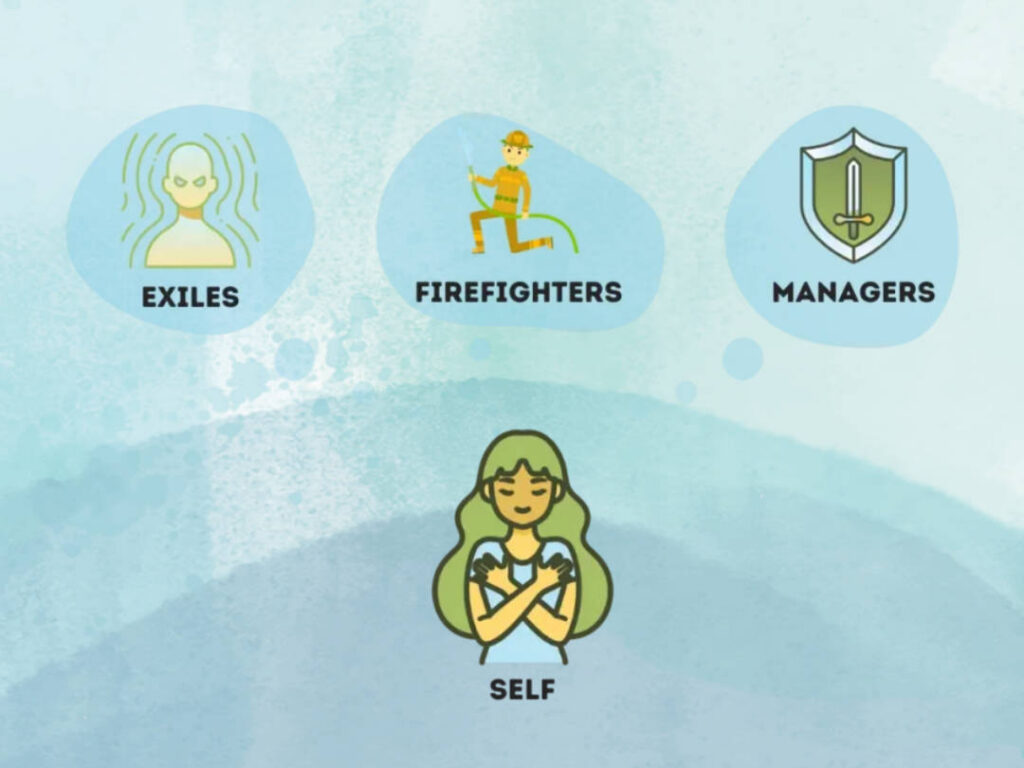
To understand Internal Family Systems therapy more fully, it is helpful to explore the three main categories of parts: Managers, Firefighters and Exiles. These categories are a description of roles within the internal system.
As human beings, we all have Managers in our system. These are protective parts that attempt to prevent emotional pain before it occurs. They are usually constructive and hard-working. A Manager part might show up as perfectionism, overthinking, people-pleasing or relentless productivity.
While these traits can be socially rewarded, they often stem from a desire to avoid criticism, rejection or failure. Managers work hard to keep life predictable and to prevent vulnerable feelings from surfacing.
When vulnerable emotions break through despite the Managers’ efforts, Firefighters step in. Firefighters are often reactive parts that want to hose the system down from difficult situations. Their goal is to extinguish emotional distress as quickly as possible. This might look like emotional eating, substance use, compulsive scrolling, gambling, angry outbursts or emotional withdrawal.
These behaviours may create longer-term consequences, however, IFS therapy understands them as urgent attempts to soothe overwhelming feelings.
Exiles are the parts that carry unresolved emotional wounds. Often formed in response to early life experiences, Exiles may hold feelings of shame, fear, grief, loneliness or unworthiness. Because their pain can feel intense, other parts work hard to keep them out of conscious awareness.
When Exiles are triggered, the system can become reactive, with Managers and Firefighters becoming activated to maintain control.
In therapy, we work gently with the parts to heal the inner Exiles. Some people might understand this concept as Inner Child healing.
The Core Self: The Foundation of Healing in IFS Therapy
One of the most hopeful aspects of Internal Family Systems therapy is its belief that everyone has a core Self. The Self is not another part. Instead, it is the calm, steady, compassionate centre within you. We see the Self as a wonderful guide that exists in all internal systems.
When you are connected to your Self, you are more likely to feel grounded, curious and confident. You may notice greater clarity, courage and compassion, both for yourself and others. In therapy, we work to increase the presence of the Self. As we get to know our parts, they learn to trust in the inner wisdom of the Self, in turn allowing them to feel seen and understood.
How IFS Therapy Can Help
Internal Family Systems therapy has been used to support people experiencing anxiety, depression, trauma, complex trauma, low self-esteem and relationship difficulties. It is particularly valued in trauma therapy because it recognises that protective responses and views this with understanding and compassion.
For example, perfectionism may be understood as a Manager part working tirelessly to prevent danger. Emotional numbness might reflect a Firefighter trying to protect you from overwhelming pain. Persistent shame may be linked to an Exile carrying early experiences of rejection or criticism.
By working directly with these parts, IFS therapy addresses the root causes of distress rather than focusing solely on symptom reduction. As parts feel heard and supported, they become less reactive. This can lead to improved emotional regulation, healthier relationships and a stronger sense of self-worth.
If you would like to learn more about Internal Family Systems therapy or book an appointment at Safe Place Therapy, we encourage you to get in touch. Healing begins with understanding, and every part of you is welcome.
Further Information
Learn more about the Internal Family Systems (IFS) evidence-based approach to individual psychotherapy developed by Richard Schwartz, here.